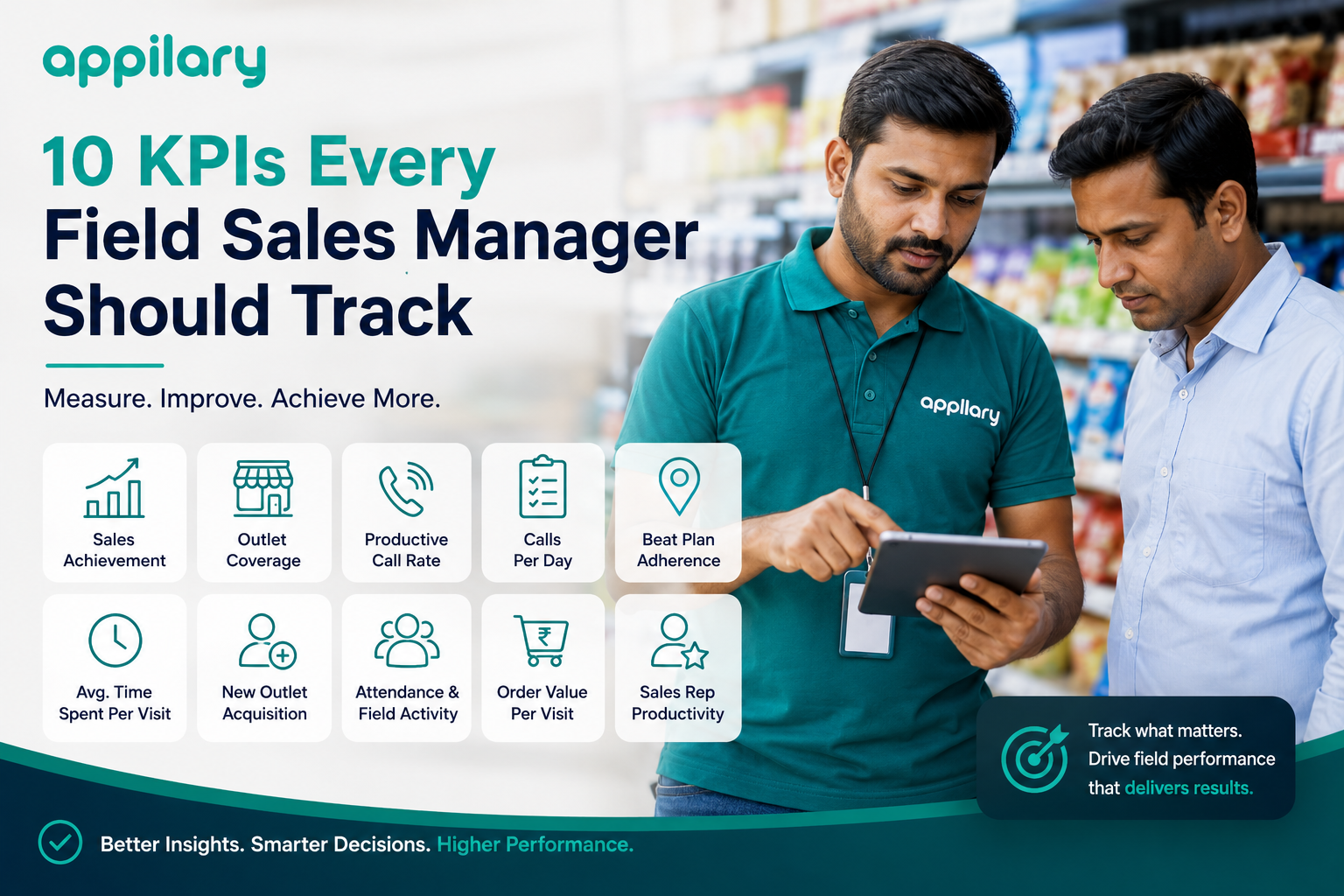
Managing a field sales team is not just about checking whether the monthly sales target was achieved. A sales manager also needs to know what is happening in the field.
Are sales representatives visiting the right outlets? Are planned visits actually being completed? How many visits are generating orders? Which territories are performing well? And where is the team losing potential sales?
This is where field sales KPIs become important.
The right KPIs help sales managers understand field sales performance, identify gaps, improve sales team productivity, and make better decisions based on actual field data.
For FMCG, retail, distribution, and other businesses that depend on an on-ground sales force, tracking these metrics becomes even more important.
What Are Field Sales KPIs?
Field sales KPIs, or Key Performance Indicators, are measurable metrics used to evaluate the performance of a field sales team.
Instead of relying only on end-of-day reports or monthly sales numbers, managers can use KPIs to understand what is happening throughout the sales process.
For example, a sales representative may achieve a high number of outlet visits but generate very few orders. Another representative may make fewer visits but generate significantly higher sales.
This is why field sales performance cannot be measured by one number alone.
A combination of sales, coverage, productivity, conversion, and execution metrics gives managers a clearer picture.
1. Sales Target Achievement
Sales target achievement is one of the most important KPIs for any field sales team.
It shows how much of the assigned sales target has been achieved during a specific period.
The basic calculation is:
Sales Target Achievement = Actual Sales ÷ Sales Target × 100
For example, if a sales representative has a monthly target of ₹10 lakh and generates ₹8 lakh in sales, the target achievement is 80%.
However, managers should not stop at this number.
If a representative is achieving only 80% of the target, the next question should be: why?
The reason could be low outlet coverage, poor conversion, stock availability, weak product distribution, or ineffective selling.
This is why sales target achievement should always be viewed along with other field sales metrics.
2. Outlet Coverage
For FMCG and retail businesses, outlet coverage is a critical field sales KPI.
Outlet coverage tells you how many of the planned outlets were actually visited by the sales representative.
For example, if a representative has 100 outlets planned for the month but visits only 80, the outlet coverage is 80%.
Low outlet coverage can result in missed sales opportunities, poor product availability, weak retailer relationships, and reduced market reach.
With field sales tracking software, managers can get better visibility into outlet visits and understand whether representatives are covering their assigned territories effectively.
3. Productive Calls
A visit does not always mean a sale.
A sales representative may visit 30 outlets but generate orders from only 18 of them.
This is why managers should track productive calls.
Productive calls measure how many field visits actually result in a successful sales outcome, such as an order.
A high number of visits with a low productive call rate can indicate that representatives are reaching outlets but struggling to convert those visits into business.
Possible reasons may include poor sales pitches, stock issues, pricing concerns, weak product knowledge, or visiting the wrong outlets.
Tracking productive calls helps managers move beyond simply measuring activity and start measuring sales productivity.
4. Sales Conversion Rate
Sales conversion rate shows how effectively your field sales team converts opportunities or customer interactions into sales.
For a field sales team, conversion can be measured through orders generated from eligible sales visits or opportunities.
A low conversion rate may indicate that representatives need better product knowledge, stronger sales pitches, better outlet targeting, or more effective sales strategies.
When conversion data is combined with outlet visits and sales data, managers can identify where the sales process is losing potential revenue.
5. Beat Plan Compliance
A beat plan defines which outlets a sales representative should visit and when those visits should happen.
Beat plan compliance measures how closely the actual field activity follows the planned beat.
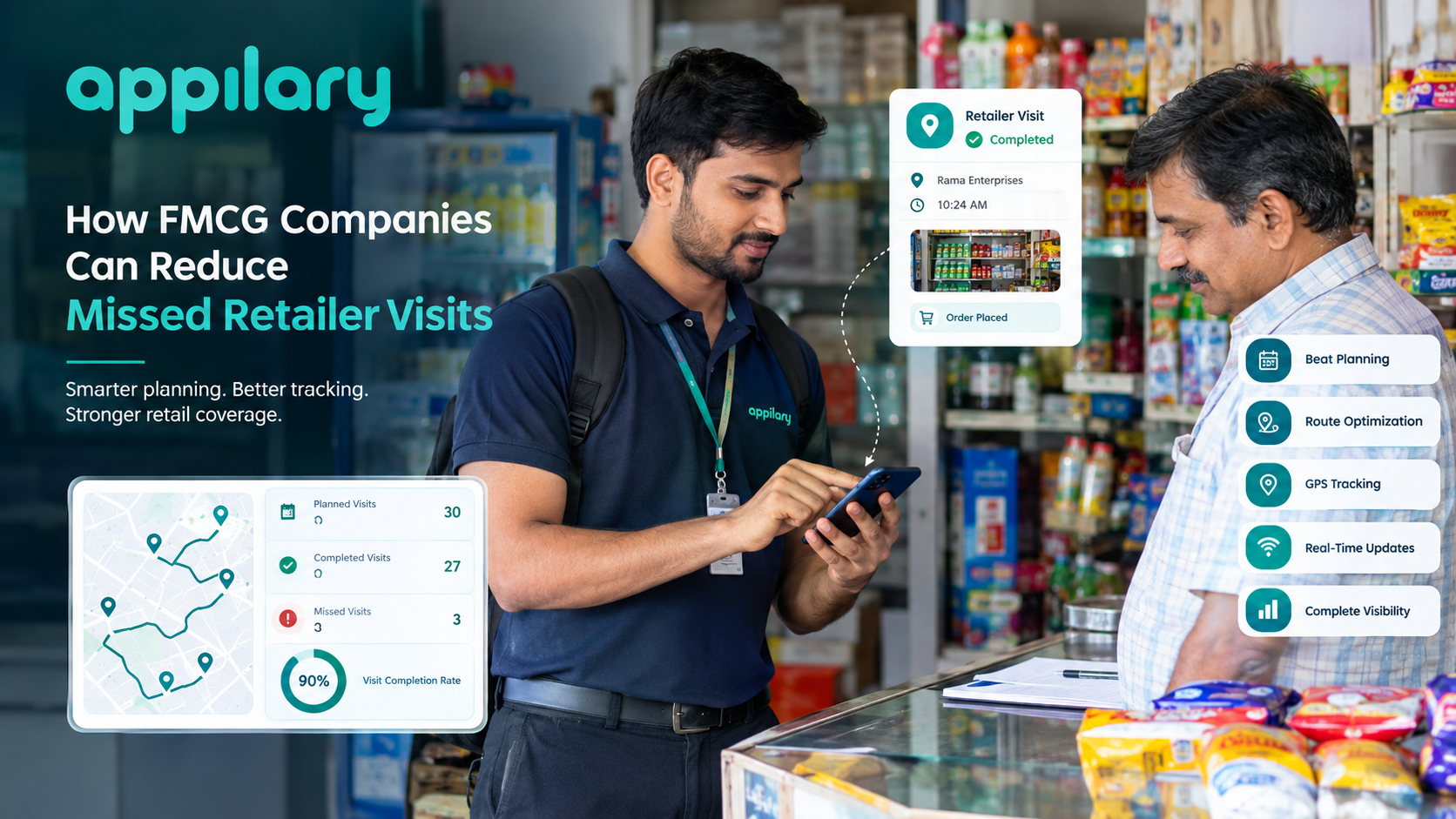
For example, if 50 outlet visits are planned and 45 are completed according to the assigned beat plan, the team has achieved 90% compliance.
Poor beat plan compliance can lead to missed outlets, inefficient routes, repeated visits, and poor territory coverage.
A sales force automation system can make beat plan monitoring easier by giving managers visibility into planned and completed visits.
Instead of waiting for a representative to submit a report, managers can review field activity and identify gaps more quickly.
6. Sales Per Visit
The number of visits alone does not tell you whether a sales representative is productive.
Sales per visit helps managers understand the average business generated from field visits.
For example, two representatives may complete the same number of visits, but one may generate significantly more sales.
This metric can help identify high-performing representatives and understand what they are doing differently.
It can also highlight opportunities for better upselling, cross-selling, product placement, and retailer engagement.
7. Average Order Value
Average Order Value, or AOV, measures the average value of each order generated by the sales team.
It is calculated by dividing total sales value by the number of orders.
A higher average order value can indicate that representatives are successfully selling more products or encouraging retailers to place larger orders.
For FMCG businesses, this KPI can be particularly useful when combined with SKU-level sales data.
Managers can identify whether representatives are selling a broader product range or relying heavily on a few popular products.
8. SKU and Product Assortment
For many FMCG businesses, getting an order is only part of the objective.
The next question is: What products are being sold?
SKU productivity helps managers understand the breadth of products being sold across outlets.
For example, if a retailer is regularly purchasing only two products from a portfolio of twenty products, there may be an opportunity to introduce additional SKUs.
Tracking product assortment can help sales teams identify cross-selling opportunities, improve product distribution, and understand which products are underperforming in specific territories.
With digital sales tracking, managers can also analyze product-level performance instead of relying only on total sales numbers.
9. Sales Representative Productivity
Sales representative productivity is one of the most useful metrics for field sales managers.
Instead of looking only at the number of visits completed, managers can evaluate overall performance using multiple factors such as:
- Sales achieved
- Target achievement
- Outlet coverage
- Productive calls
- Conversion rate
- Beat compliance
- Average order value
This provides a much better understanding of how effectively each representative is using their time in the field.
A good field sales management system can bring these metrics together in one dashboard, allowing managers to compare performance and identify where coaching or support is required.
10. Territory-Wise Sales Performance
Overall sales numbers can sometimes hide problems within individual territories.
For example, your company may be achieving its overall target while one particular territory is consistently underperforming.
Tracking territory-wise sales performance helps managers understand:
- Which territories are growing
- Which territories are declining
- Where outlet coverage is low
- Where conversion is weak
- Which products are performing better
- Where additional sales effort may be required
This becomes especially valuable for businesses managing large field sales teams across multiple cities, regions, distributors, or territories.
Why Field Sales Automation Makes KPI Tracking Easier
Traditionally, sales managers often depend on spreadsheets, phone calls, WhatsApp updates, and end-of-day reports to understand field activity.
The problem is that this information can be delayed, incomplete, or difficult to verify.
Field sales automation software helps bring field activity and sales data into a centralized system.
Depending on the solution, managers can track information such as:
- Sales representative attendance
- Outlet visits
- GPS-based field activity
- Beat plan execution
- Order booking
- Productive calls
- Sales performance
- Product and SKU performance
- Territory performance
- Daily and monthly targets
This gives managers a more real-time view of what is happening in the field.
Instead of asking, "What happened yesterday?", managers can focus on questions like, "Where is the team losing opportunities today?"
From Field Activity to Business Results
One of the biggest advantages of tracking field sales KPIs is that it helps connect daily activity with actual business outcomes.
For example, if outlet coverage is high but sales remain low, the problem may be conversion or product availability.
If visits are low but conversion is high, the representative may have strong selling skills but insufficient territory coverage.
If beat compliance is low and sales are falling, the territory may require better route planning or stronger execution.
This is where field sales automation becomes more than just a tracking system.
It gives managers the data they need to understand what is happening, identify problems, and take action.
How to Build a Better Field Sales KPI Dashboard
A useful KPI dashboard should not overwhelm managers with hundreds of numbers.
Start with the metrics that directly influence business performance:
Sales target achievement, outlet coverage, productive calls, conversion rate, beat compliance, sales per visit, average order value, SKU productivity, sales representative productivity, and territory performance.
Then monitor these metrics regularly and compare them against previous periods, targets, territories, and individual representatives.
The goal is not simply to collect more data.
The goal is to turn field data into better decisions.
Final Thoughts
Successful field sales management is not about counting how many visits a representative makes.
It is about understanding whether those visits are creating meaningful business results.
By tracking the right field sales KPIs, managers can identify performance gaps, improve outlet coverage, increase sales productivity, strengthen territory execution, and help their teams achieve targets more consistently.
And when these KPIs are tracked through field sales automation software, managers get a clearer and more timely view of what is happening across the field.
The result is a sales operation that is not only easier to monitor but also easier to improve.
Because in modern field sales, the real advantage is not simply having more data.
It is knowing what to do with it.