In the FMCG industry, sales growth depends on more than having the right products, pricing, and distribution network. It also depends on how consistently sales representatives reach retailers, execute planned visits, capture orders, check product availability, and maintain relationships across the market.
A missed retailer visit may look like a small operational issue. But when missed visits happen across hundreds or thousands of outlets, they can create significant gaps in retailer coverage, sales execution, product availability, and revenue opportunities.
For FMCG companies managing large field sales teams, the challenge is not simply knowing which retailers should be visited. The real challenge is ensuring that planned retailer visits actually happen.
This is where FMCG field sales automation, retailer visit tracking, beat planning software, route adherence, and real-time field monitoring can make a measurable difference.
What Is a Missed Retailer Visit?
A missed retailer visit occurs when a sales representative is expected to visit a retailer according to the company's beat plan or Permanent Journey Plan (PJP), but the visit is not completed as scheduled. For example, a sales representative may have 25 retailers assigned for a particular day. The plan:
25 planned visits → 25 expected retailer interactions
But the actual execution may be:
25 planned visits → 19 completed visits → 6 missed visits
Those six missed visits represent more than six incomplete tasks.
They may also mean:
- No order was captured
- Product availability was not checked
- New schemes were not communicated
- Competitor activity was not observed
- Shelf or merchandising conditions were not monitored
- Retailer requirements were not recorded
- Potential sales were delayed or lost
When this happens repeatedly, retailer coverage begins to decline.
Why Missed Retailer Visits Are a Serious Problem for FMCG Companies
FMCG sales depend heavily on distribution reach and retail availability.
A retailer that is not visited may continue selling competing products, run out of stock, miss a promotional opportunity, or simply receive less attention from the brand.
Over time, inconsistent visits can affect several areas of the business.
1. Lost Sales Opportunities
A missed visit can mean a missed order.
If a retailer normally places an order during every scheduled visit, skipping that visit can delay replenishment and reduce sales.
2. Poor Outlet Coverage
FMCG companies often manage thousands of outlets across territories.
Even a small percentage of missed visits can result in significant coverage gaps when multiplied across a large sales force.
3. Reduced Retailer Engagement
Regular retailer interactions help sales representatives understand retailer requirements, communicate schemes, collect feedback, and maintain relationships.
Irregular visits can weaken that relationship.
4. Product Availability Issues
Without regular visits, sales teams may not identify stock-outs or changing retailer demand quickly enough.
This can directly affect product availability at the point of sale.
5. Reduced Visibility Into Market Execution
When visits are tracked manually, managers may discover missed coverage only after the day or week has ended.
By then, the opportunity to correct the problem may already be gone.
Why Do FMCG Sales Teams Miss Retailer Visits?
Missed retailer visits usually do not happen because sales representatives simply decide not to visit an outlet.
In many cases, the problem comes from operational challenges.
1. Poor Beat Planning
If retailers are not organized into practical daily beats, representatives may spend too much time travelling between outlets.
This reduces the time available for actual selling.
A good FMCG beat plan should consider:
- Retailer location
- Territory
- Visit frequency
- Outlet potential
- Sales representative capacity
- Market priorities
- Travel time
2. Inefficient Sales Routes
A representative may be assigned the correct retailers but still struggle to complete the day's plan because the route is inefficient.
For example:
Retailer A → Retailer B → Retailer C → Retailer D
may require significantly less travel than:
Retailer A → Retailer D → Retailer B → Retailer C
Route planning therefore plays an important role in reducing missed visits.
3. No Real-Time Visibility
Traditional reporting methods such as spreadsheets, phone calls, WhatsApp messages, and end-of-day reports make it difficult for managers to know what is happening in the field in real time.
A manager may only discover that six retailers were missed after the working day is over.
4. Unplanned Field Activities
Unexpected delays, retailer closures, additional orders, traffic, meetings, or other field activities can affect the day's schedule.
Without real-time monitoring, it becomes difficult to identify and correct these deviations.
5. Poor PJP Management
A Permanent Journey Plan defines which retailers should be visited on specific days and at specific frequencies.
If PJP management is not structured properly, some retailers may receive too many visits while others receive too few.
6. Manual Visit Reporting
When representatives manually submit visit reports, managers have limited ability to verify whether the visit actually happened at the intended outlet and time.
This can make retailer coverage data less reliable.
How FMCG Companies Can Reduce Missed Retailer Visits
Reducing missed visits requires more than simply telling sales representatives to visit more outlets.
Companies need a structured field execution process that connects planning, routing, field activity, verification, monitoring, and analysis.
1. Create Structured FMCG Beat Plans
The first step is to create a practical beat plan.
Retailers should be organized according to factors such as:
- Geography
- Market
- Territory
- Retailer type
- Sales potential
- Visit frequency
- Distributor
- Sales representative
A structured beat plan ensures that representatives know exactly which outlets they need to cover.
It also gives managers a measurable benchmark for evaluating outlet coverage.
2. Use PJP Management to Maintain Consistent Coverage
A PJP helps define recurring retailer visits.
For example:
Monday → Market A
Tuesday → Market B
Wednesday → Market C
Thursday → Market D
Friday → Market A
This creates consistency in retailer coverage.
Instead of deciding every morning which outlets to visit, representatives can work according to a predefined journey plan.
The PJP can then be reviewed periodically based on sales performance, retailer potential, geography, and changing market conditions.
3. Optimize Daily Sales Routes
Beat planning determines which retailers should be visited.
Route planning determines how those retailers can be visited efficiently.
FMCG companies can use route planning and GPS-based field sales technology to reduce unnecessary travel and improve daily outlet coverage.
The objective should not simply be to increase the number of visits.
It should be to maximize productive retailer visits within available working hours.
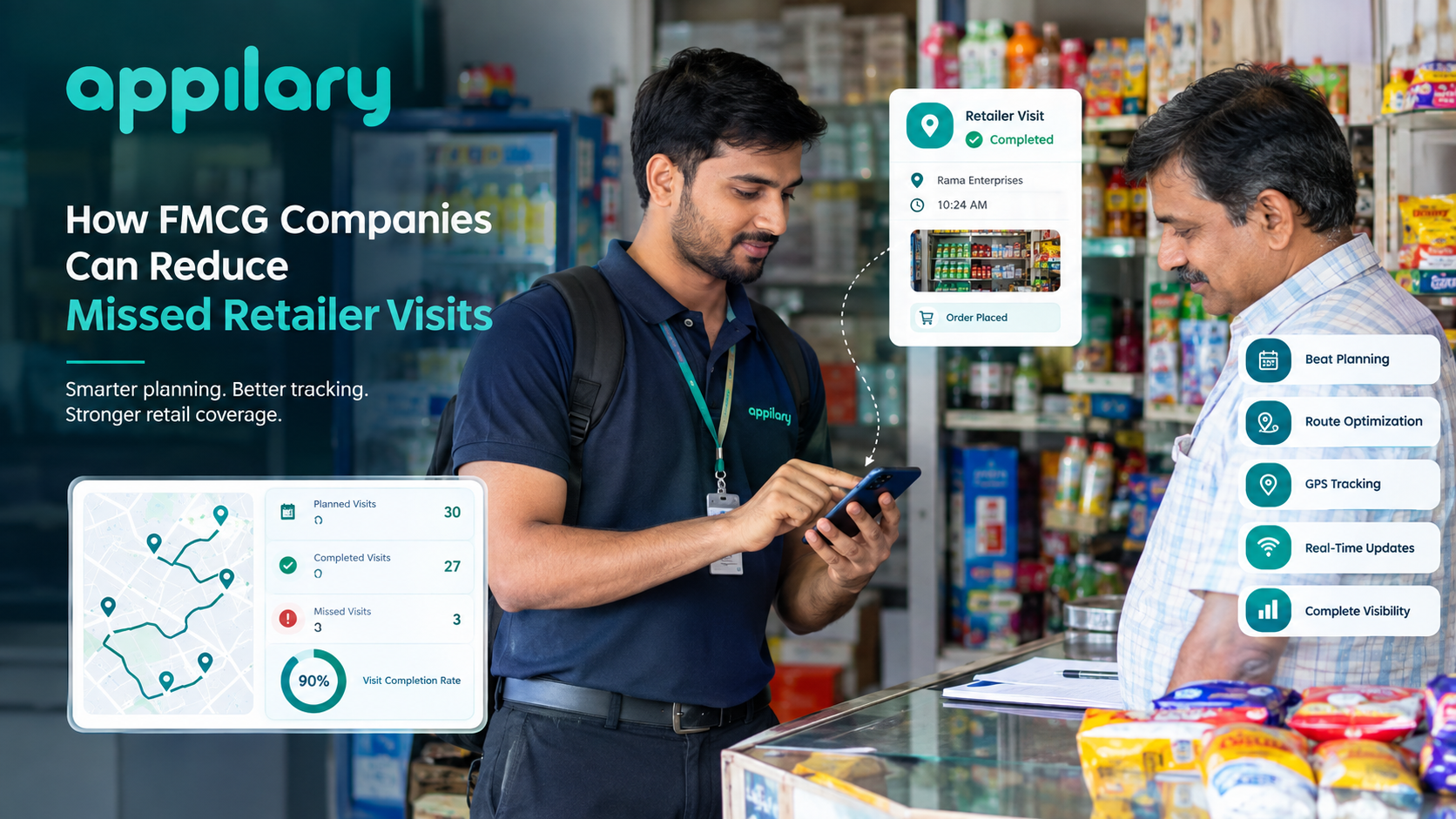
4. Track Planned Visits vs. Actual Visits
One of the most important metrics for reducing missed visits is the comparison between planned and completed visits.
For example:
Planned visits - 30
Completed visits - 26
Missed visits - 4
Visit completion rate - 86.7%
This gives managers a clear view of field execution.
Without this comparison, a manager may know that a representative visited 26 outlets but may not realize that four important retailers were missed.
5. Use GPS-Based Visit Verification
GPS and geo-tagged visit tracking can provide greater confidence that a representative actually reached the intended retailer location.
A field sales tracking system can associate a visit with:
- Location
- Time
- Retailer
- Sales representative
- Visit activity
- Order information
- Photos
- Remarks
This creates a more reliable record of field execution.
Geo-fenced attendance and outlet verification can also help reduce false check-ins and improve field accountability.
6. Monitor Route Adherence
A planned route is useful only when it is followed effectively.
Route adherence tracking allows managers to compare the planned journey with actual field movement.
This can help identify:
- Route deviations
- Delayed visits
- Unplanned stops
- Incomplete routes
- Excessive travel
- Repeated coverage issues
Instead of waiting for an end-of-day report, managers can identify execution problems while the field team is still working.
7. Prioritize High-Value Retailers
Not every retailer necessarily requires the same visit frequency.
Companies can segment outlets according to:
- Sales volume
- Growth potential
- Product category
- Stock movement
- Strategic importance
- Retailer type
- Market opportunity
High-potential outlets can receive more frequent visits, while lower-priority outlets can follow an appropriate coverage frequency.
This helps sales teams use their available field time more effectively.
8. Give Sales Managers Real-Time Field Visibility
A modern field force management system should allow managers to understand what is happening across their territories without relying entirely on manual updates.
A centralized dashboard can provide visibility into:
- Sales representative attendance
- Planned visits
- Completed visits
- Missed visits
- Outlet coverage
- Route adherence
- Orders
- Sales performance
- Productivity
- Target achievement
This changes field management from reactive reporting to proactive execution.
9. Set Alerts for Missed or Delayed Visits
Real-time alerts can help managers identify exceptions quickly.
For example, a manager could be alerted when:
- A planned visit is delayed
- A retailer is skipped
- A route is significantly deviated from
- A representative has low visit completion
- A priority retailer has not been covered
The purpose of alerts is not simply to monitor employees.
The bigger objective is to help managers take corrective action before a missed visit becomes a missed sales opportunity.
10. Analyse Repeated Coverage Gaps
A single missed visit may not indicate a major problem.
Repeated missed visits are different.
Suppose a particular retailer is missed every Friday.
That could indicate:
- Poor route design
- Excessive workload
- Incorrect retailer timing
- Traffic problems
- Retailer availability issues
- Incorrect PJP scheduling
Historical field data can help managers identify these patterns and redesign the beat or route.
Technology Can Turn Retailer Visit Tracking Into a Continuous Process
Traditional field sales management often follows this model:
Plan → Field Work → Manual Report → Manager Review
The problem is that the manager receives visibility only after the activity has already happened.
A modern FMCG field sales automation workflow can look more like:
Plan → Assign → Navigate → Visit → Verify → Capture → Monitor → Analyse → Improve
This creates a continuous feedback loop.
For example:
- Retailers are assigned to a beat.
- The PJP determines when those retailers should be visited.
- The sales representative receives the daily route through a mobile application.
- GPS and location-based tools support field execution.
- The representative checks in at the retailer.
- Orders, stock information, surveys, merchandising activities, or photographs can be captured.
- Managers see field activity through a centralized dashboard.
- Planned and completed visits are compared.
- Missed visits and route deviations are identified.
- The next beat plan can be improved using actual field data.
This makes retailer visit management more measurable and actionable.
KPIs FMCG Companies Should Track to Reduce Missed Visits
Companies cannot improve what they do not measure.
Some of the most useful retailer coverage and field sales KPIs include:
Planned Visit Completion Rate
Measures how many planned retailer visits were actually completed.
Formula:
Completed Visits ÷ Planned Visits × 100
Missed Visit Rate
Measures the percentage of planned visits that were not completed.
Formula:
Missed Visits ÷ Planned Visits × 100
Outlet Coverage
Measures the percentage of targeted outlets covered during a defined period.
Beat Adherence
Measures how closely field representatives follow their assigned beat plan.
Route Adherence
Measures how closely actual field movement follows the planned route.
Productive Call Rate
Measures how many retailer visits generated a meaningful sales activity, such as an order.
Average Visits per Representative
Helps managers understand daily field productivity.
Priority Outlet Coverage
Measures whether important or high-potential retailers are receiving the required level of coverage.
Tracking these metrics together provides a much better picture of field execution than simply measuring total visits.
The Bigger Goal: Improve Productive Retailer Coverage
The objective of reducing missed retailer visits is not to make sales representatives complete the maximum possible number of visits.
It is to ensure that the right retailers are visited at the right frequency with the right sales activities.
A representative completing 30 poorly planned visits may generate less value than another representative completing 22 well-planned, productive visits.
Therefore, FMCG companies should focus on:
Right Outlet + Right Frequency + Right Route + Right Activity + Right Follow-up
This approach helps connect field productivity with actual business outcomes.
Conclusion
Missed retailer visits are often treated as a field-team productivity issue, but the underlying problem is usually broader.
Poor beat planning, inefficient routes, weak PJP management, limited visibility, manual reporting, and lack of real-time field monitoring can all contribute to retailer coverage gaps.
FMCG companies can reduce missed visits by creating structured beat plans, optimizing routes, managing PJPs, verifying retailer visits, monitoring route adherence, prioritizing high-value outlets, and analysing planned versus actual field execution.
With FMCG field sales automation and retailer visit tracking software, businesses can move beyond simply asking whether a sales representative completed their day.
They can understand:
Which retailers were planned?
Which retailers were visited?
Which visits were missed?
Why were they missed?
What happened at each outlet?
And how can the next route be improved?
That visibility is what turns retailer visit management from a manual reporting exercise into a measurable, data-driven field sales process.
Ultimately, better retailer coverage means more consistent market execution, stronger retailer relationships, improved product availability, and more opportunities to convert every field visit into business growth.