Introduction: The New Era of FMCG Trade Merchandising
In the FMCG industry, getting a product into a retail store is only half the job. The real challenge is ensuring that the product is available, correctly displayed, visible to shoppers, and supported by effective promotional activities.
Imagine a sales representative visiting 40 retail outlets in a day. At every store, they need to check product availability, inspect shelf placement, verify promotional displays, capture photographs, and report execution issues. Multiply these activities across hundreds of representatives and thousands of outlets, and managing retail execution becomes a significant operational challenge.
Traditional merchandising methods often rely on manual inspections, spreadsheets, photographs, and periodic reporting. Although these methods remain useful, they can make it difficult for FMCG brands to obtain consistent, timely, and actionable information from the retail market.
This is where Artificial Intelligence (AI) is creating new opportunities.
By combining AI-powered image recognition, mobile applications, retail analytics, and field sales automation, FMCG companies can improve shelf visibility, monitor merchandising standards, identify execution gaps, and make more informed business decisions.
AI is transforming trade merchandising from a largely manual monitoring process into a more intelligent, measurable, and data-driven approach to retail execution.
Let's explore how this transformation works and why it matters for modern FMCG brands.
What Is Trade Merchandising in the FMCG Industry?
Trade merchandising refers to the activities involved in presenting, positioning, and promoting products within retail outlets to improve visibility and support sales performance.
For FMCG brands, these activities may include:
- Ensuring products are displayed in the appropriate shelf locations.
- Monitoring product availability and shelf presence.
- Checking planogram compliance and product arrangement.
- Verifying promotional displays and point-of-sale materials.
- Monitoring competitor visibility and retail conditions.
- Evaluating the execution quality of field teams.
For example, a personal care brand may require its products to occupy a designated shelf section, maintain a particular display arrangement, and feature approved promotional materials.
Without consistent monitoring, these standards may not be implemented equally across every outlet.
Trade merchandising helps bridge the gap between a brand's retail strategy and what actually happens inside the store.
Why Traditional Trade Merchandising Is No Longer Enough
Managing merchandising across a large retail network requires more than collecting reports. Businesses need reliable information that helps them understand execution quality and respond to problems.
1. Limited Visibility Into Retail Shelves
Managers cannot physically inspect every store every day. They often depend on information submitted by field representatives to understand how products are displayed.
This creates a visibility gap between the retail outlet and the decision-maker.
2. Time-Consuming Manual Audits
Representatives may spend considerable time counting products, documenting shelf conditions, checking displays, and completing reports.
Manual processes can also introduce inconsistencies, making it harder to compare performance across different stores and territories.
3. Delayed Identification of Execution Gaps
A missing product, incorrect display, or poorly executed promotion may remain unnoticed until a report is reviewed.
When issues are identified late, opportunities for timely corrective action can be lost.
4. Difficulty Maintaining Merchandising Standards
FMCG brands frequently operate across different store formats, regions, and distribution networks. Maintaining consistent merchandising standards across all these environments can be challenging.
5. Disconnected Field Data and Business Decisions
Even when companies collect large amounts of retail data, that information may not be organized in a way that helps managers prioritize action.
The challenge is not simply collecting more data. It is converting field observations into useful business insights.
How AI Is Changing Trade Merchandising for FMCG Brands
AI enables FMCG companies to analyse retail information more efficiently, identify potential problems, and support better merchandising decisions.
1. AI-Powered Shelf Image Recognition
One of the most promising applications of AI in FMCG merchandising is image recognition.
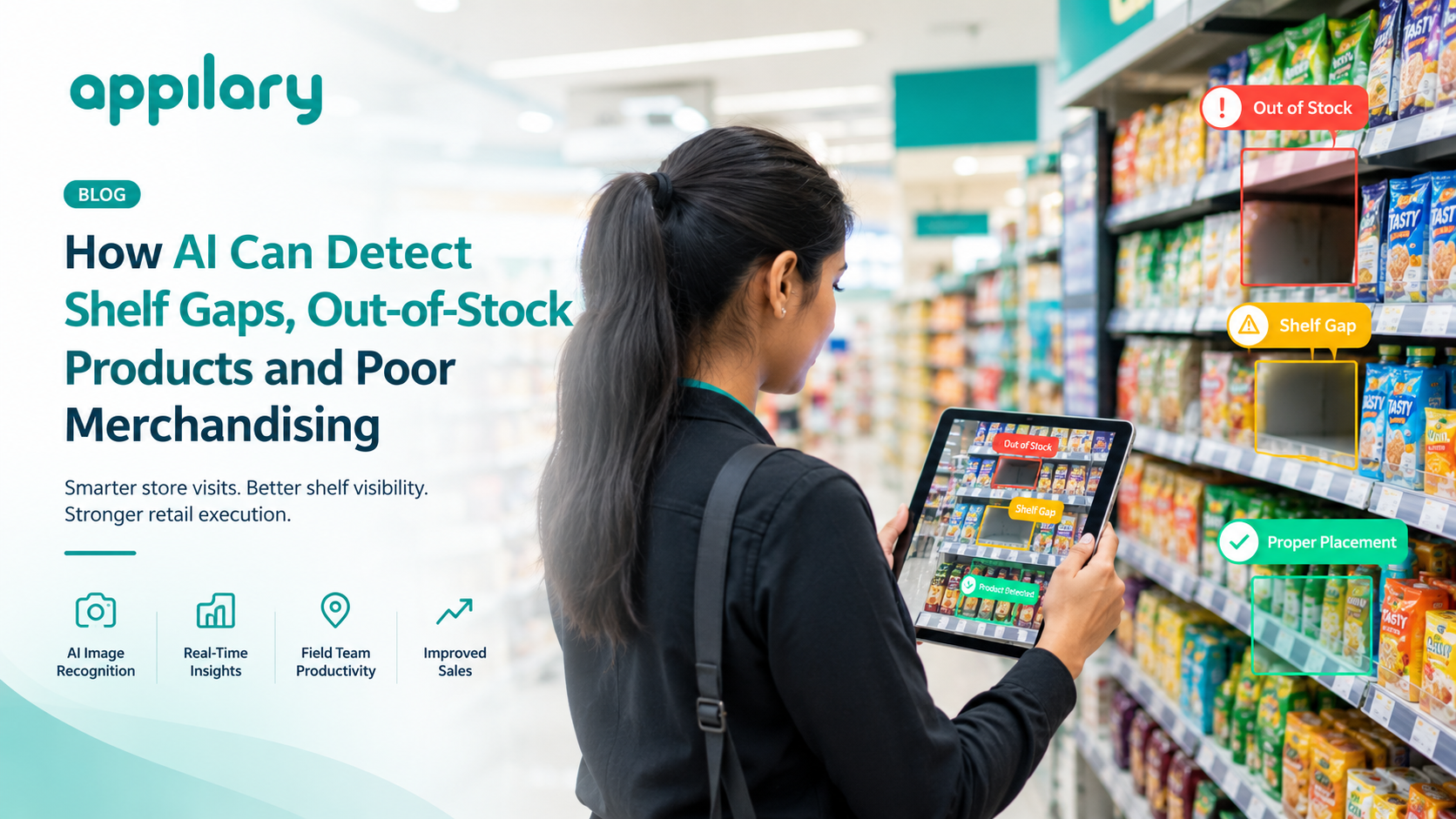
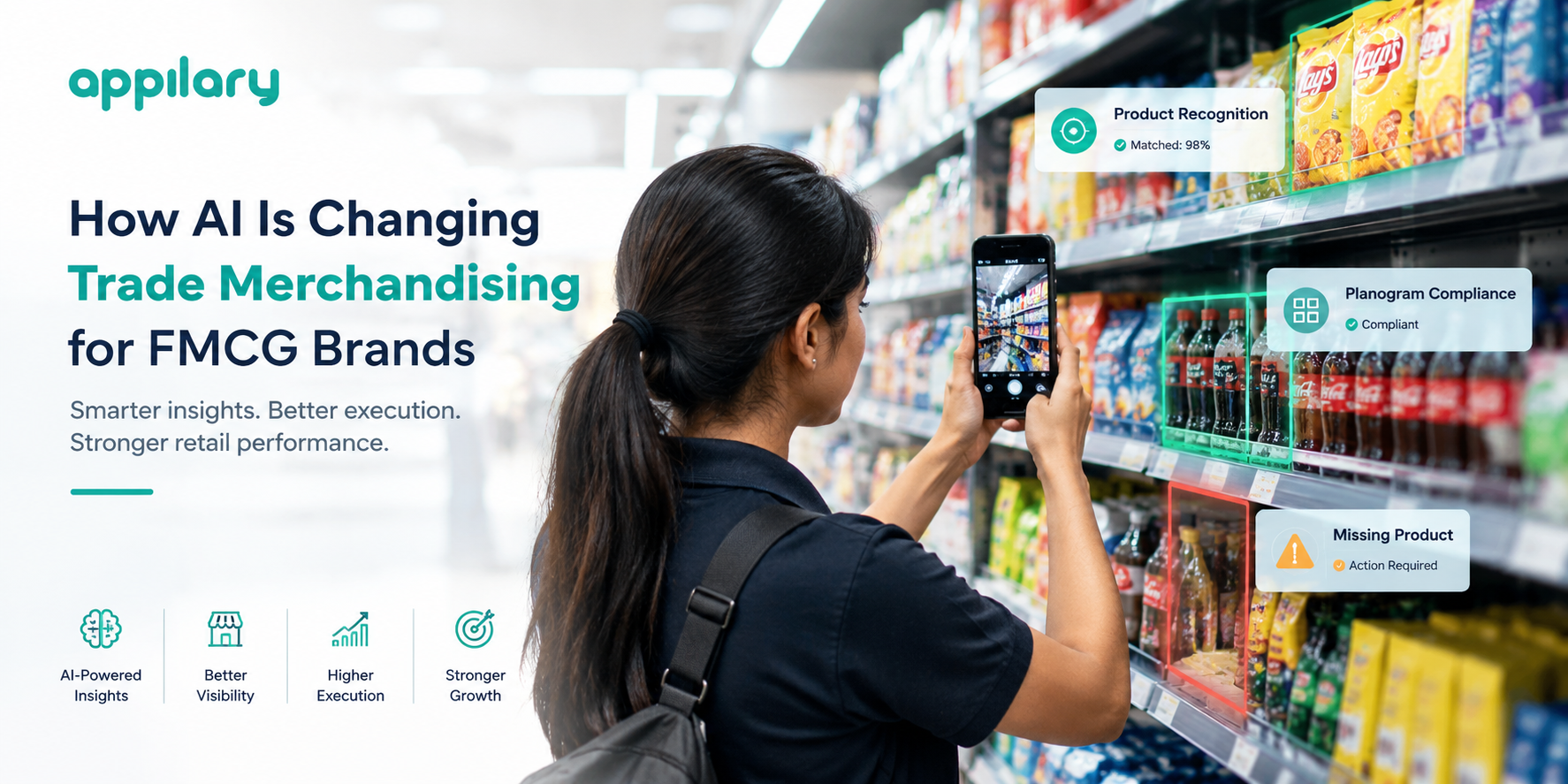
During a store visit, a field representative captures a photograph of a retail shelf using a mobile application. An AI-enabled system can analyse the image to recognize supported products, assess shelf presence, and identify potential display issues.
Depending on the solution and image quality, this process may help teams identify:
- Products missing from their expected shelf positions.
- Incorrect product placement.
- Potential shelf availability issues.
- Differences in product-facing arrangements.
- Visibility of selected products or promotional displays.
Example: A beverage brand wants to understand whether its products are consistently displayed across 2,000 retail outlets. Instead of depending entirely on manual photograph reviews, it can use AI-assisted shelf analysis to identify outlets that require further attention.
This helps merchandising managers prioritize reviews and focus on stores where execution may need improvement.
2. Smarter Planogram Compliance Monitoring
A planogram defines the intended arrangement of products on a retail shelf. It helps brands communicate expectations about product placement, shelf space, and display organization.
However, verifying planogram compliance manually across a large retail network can consume significant time.
AI-assisted image analysis can compare shelf photographs against configured merchandising rules or reference layouts to identify possible deviations.
For example, a packaged food brand may require specific products to be displayed together in a designated shelf section. If the captured image indicates that the arrangement differs from the expected layout, the system can flag the outlet for verification.
This helps brands monitor merchandising consistency and take corrective action where necessary.
3. Improved Product Availability and Shelf Visibility
Product availability is essential to retail performance. However, having stock in a store does not necessarily mean that shoppers can easily find it on the shelf.
Products may be misplaced, hidden behind other items, or missing from their expected display locations.
AI-powered shelf monitoring can help identify potential availability and visibility issues from retail images. When combined with inventory and sales information, these insights can help teams investigate whether an issue relates to replenishment, product placement, or another operational factor.
For FMCG brands, this creates an opportunity to connect retail visibility with more effective field execution.
4. Intelligent Monitoring of Promotional Displays
Promotional activities are an important part of FMCG marketing. Brands invest in displays, posters, shelf strips, promotional stands, and other point-of-sale materials to attract customer attention.
But launching a campaign does not guarantee that it will be executed correctly at every store.
AI-assisted retail monitoring can help teams verify whether selected promotional materials are present and whether configured display requirements appear to have been followed.
For example, a personal care brand running a seasonal promotion can use store photographs to monitor campaign implementation across participating outlets.
This gives managers a clearer view of promotional execution and helps them identify stores that may require follow-up.
5. Real-Time Retail Execution Visibility
Traditional reporting processes can create a delay between an activity taking place in a store and a manager learning about it.
Connected field applications and analytics platforms can reduce this gap by making store visit information and merchandising evidence available for review soon after submission and processing.
Managers can use dashboards to monitor relevant information, such as:
- Completed store visits.
- Field activity and outlet coverage.
- Submitted shelf photographs.
- Identified merchandising issues.
- Follow-up requirements and execution trends.
The availability of real-time information depends on connectivity, system configuration, and processing workflows. Nevertheless, faster access to field information can help businesses respond more effectively to operational challenges.
6. Smarter Field Team Prioritization
AI can support merchandising decisions beyond the shelf itself.
When combined with field activity, outlet importance, visit history, and sales performance, analytical systems can help managers identify which stores deserve greater attention.
For example, an outlet with recurring shelf visibility issues may need a follow-up visit, while another outlet with consistent execution may require less frequent intervention.
Such prioritization helps field teams use their time more effectively and focus on activities that support business objectives.
7. Data-Driven Merchandising Decisions
The real value of AI becomes clearer when retail observations are connected to business intelligence.
Instead of reviewing isolated photographs and individual reports, managers can analyse patterns across outlets, products, territories, and campaigns.
They can investigate questions such as:
- Which territories have recurring merchandising issues?
- Where is product visibility below the desired standard?
- Which outlets require corrective action?
- Are promotional displays being implemented as planned?
- Which field activities are associated with better execution?
These insights can support better planning, performance reviews, and resource allocation.
AI does not automatically guarantee better sales. Its value depends on the accuracy of the data, the quality of the analysis, and how effectively businesses act on the findings.
AI in FMCG Trade Merchandising: Traditional vs. Intelligent Approach
Traditional approach AI-enabled approach Manual shelf inspection AI-assisted shelf image analysis Photograph review by managers Automated identification of potential issues Periodic reporting Faster access to submitted field information Manual planogram verification Image-assisted compliance checks Reactive store follow-ups Data-informed prioritization Disconnected reports Integrated retail performance insights
The purpose of AI is not necessarily to eliminate manual inspections. Instead, it can reduce repetitive work, support verification, and help teams concentrate on decisions that require human judgment.
Key Benefits of AI-Powered Trade Merchandising for FMCG Brands
Greater Retail Visibility
Understand how products are displayed across retail outlets and identify potential gaps in merchandising execution.
Improved Operational Efficiency
Reduce repetitive manual checks and help field teams and managers spend more time on higher-value activities.
More Consistent Merchandising Standards
Use defined merchandising rules and image-based verification to support consistent execution across different outlets.
Faster Identification of Retail Issues
Highlight potential shelf, display, and promotional problems so that teams can investigate and respond sooner.
Better Field Force Productivity
Combine outlet information and execution insights to help representatives prioritize store visits and follow-up activities.
More Informed Business Decisions
Connect retail observations with operational and sales data to identify patterns, evaluate performance, and improve planning.
How to Implement AI in Trade Merchandising Successfully
Adopting AI requires more than introducing an image recognition tool. FMCG brands should establish a clear implementation strategy.
Step 1: Identify the business problem. Determine whether the priority is shelf visibility, planogram compliance, promotional monitoring, field productivity, or another measurable challenge.
Step 2: Standardize merchandising requirements. Define what a successful store visit and merchandising execution should look like.
Step 3: Improve field data quality. Ensure that photographs, outlet information, visit records, and product references are reliable enough to support meaningful analysis.
Step 4: Integrate AI with field workflows. Make image capture, reporting, issue identification, and follow-up practical for representatives and managers.
Step 5: Track meaningful performance indicators. Monitor metrics such as outlet coverage, compliance rates, issue resolution time, and the quality of submitted evidence.
Step 6: Review and improve continuously. Use field feedback and performance data to refine workflows, improve adoption, and evaluate whether the technology is delivering measurable value.
A phased implementation allows brands to learn from real retail conditions before expanding the solution across their entire network.
The Future of AI in FMCG Trade Merchandising
The next stage of trade merchandising will be shaped by the integration of AI, mobile applications, computer vision, and advanced analytics.
As these technologies develop, FMCG companies will have more opportunities to understand retail conditions, monitor merchandising standards, and prioritize field activities using better evidence.
Future applications may include more sophisticated product recognition, predictive identification of recurring execution problems, smarter outlet prioritization, and deeper connections between retail observations and business outcomes.
However, technology alone is not enough. Successful implementation will depend on reliable data, clearly defined processes, employee adoption, and the ability to convert insights into action.
FMCG brands that combine these elements can build a more measurable and responsive approach to retail execution.
Conclusion
AI is changing trade merchandising by helping FMCG brands move beyond manual inspections and fragmented reporting toward more intelligent retail monitoring and data-driven decision-making.
From shelf image recognition and planogram compliance to promotional display monitoring and field team prioritization, AI can help businesses understand what is happening at the retail level and identify where improvement is needed.
The opportunity lies in connecting these insights with practical field workflows and consistent merchandising standards.
For brands looking to strengthen retail visibility and improve field execution, AI-powered merchandising is becoming an important capability to explore.