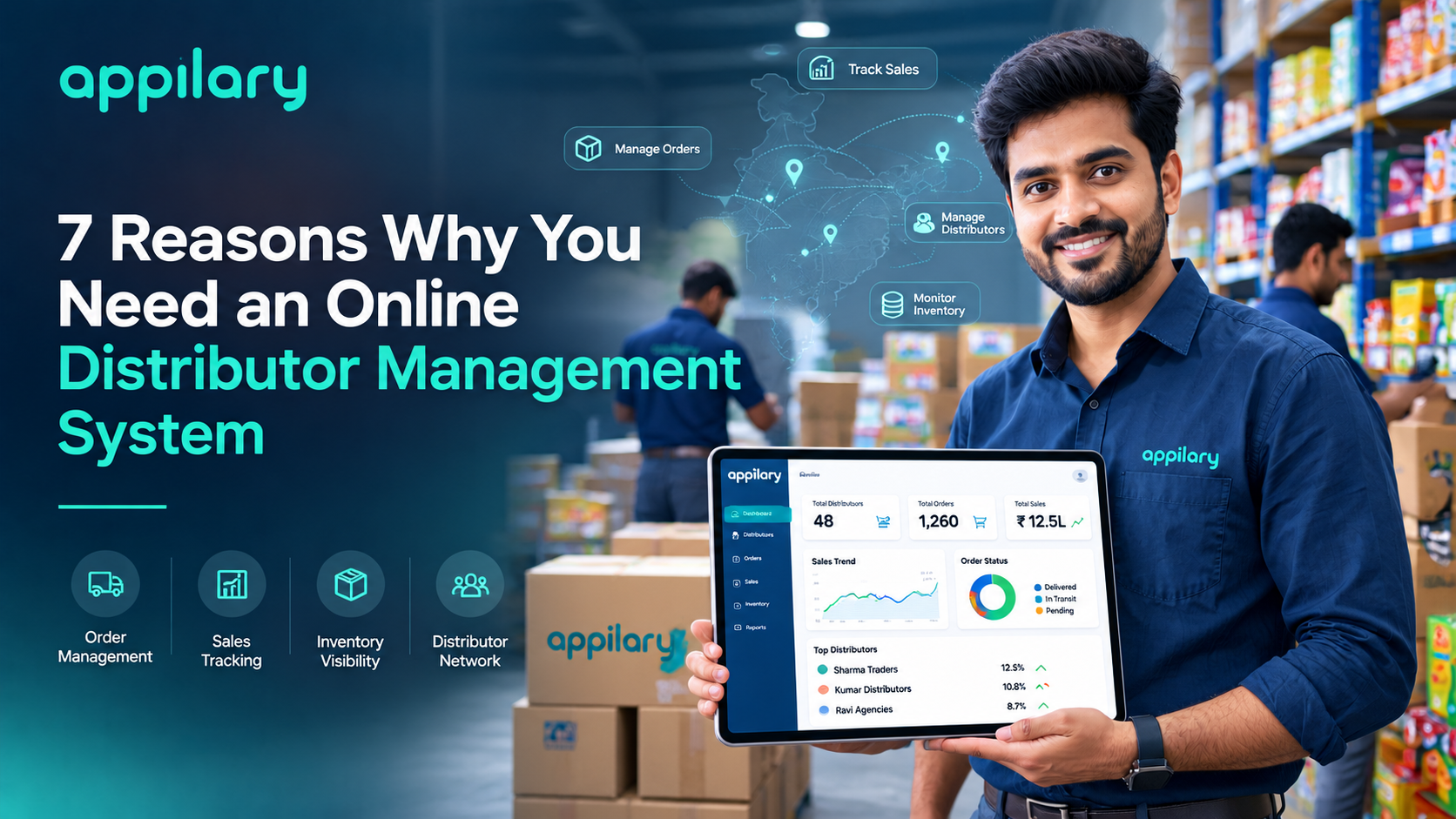
Managing distributors becomes increasingly difficult as a business grows. More distributors mean more orders, more inventory, more sales data, more communication, and more opportunities for information to get lost between teams.
Many businesses still depend on spreadsheets, phone calls, WhatsApp messages, and manual reports to manage their distributor network. While these methods may work when the business is small, they can become slow, difficult to track, and prone to errors as the distribution network expands.
This is where an online distributor management system can make a significant difference.
A distributor management system brings distributor information, orders, inventory, sales activities, payments, and performance data into one centralized platform. It helps businesses improve visibility across their distribution network while making day-to-day operations easier for both sales teams and distributors.
Here are seven important reasons why your business should consider using an online distributor management system.
1. Manage Your Entire Distributor Network in One Place
When distributor information is spread across spreadsheets, emails, messages, and different systems, getting a complete picture of your network can be difficult.
An online distributor management system provides a centralized platform where businesses can manage distributor profiles, locations, contact details, assigned sales teams, orders, sales performance, and other important information.
Instead of searching through multiple files or asking different team members for updates, managers can access the information they need from a single system.
This becomes especially useful for FMCG companies and businesses managing distributors across multiple cities, states, or regions.
A centralized distributor management system helps create better visibility and makes distributor network management much more organized.
2. Improve Order Management
Order management is one of the most important parts of distribution operations.
Manual order collection can create several problems. Orders may be entered incorrectly, updates may be delayed, or sales teams may not have visibility into the current order status.
With distributor management software, businesses can streamline the order management process.
Sales teams can record orders digitally, while managers can monitor order activity and status from a centralized dashboard. Depending on the system, distributors can also access relevant information about their orders and inventory.
This helps reduce manual work and makes it easier to identify pending, completed, or delayed orders.
Better order visibility can also help businesses respond faster to distributor requirements and improve the overall sales process.
3. Get Better Visibility Into Sales Performance
Knowing how much your distributors are selling is essential for making informed business decisions.
Without centralized sales data, managers may have to wait for reports or manually combine information from different sources. This can make it difficult to identify which distributors, products, territories, or sales teams are performing well.
An online distributor management system can bring sales information together and provide a clearer view of performance.
Managers can use dashboards and reports to monitor important metrics such as sales volume, order frequency, product movement, distributor performance, and territory-wise sales.
This makes it easier to identify trends and take action instead of relying only on assumptions or delayed reports.
4. Track Inventory More Effectively
Inventory problems can directly affect sales.
If distributors do not have enough stock, products may become unavailable at retail outlets. On the other hand, excessive inventory can increase holding costs and create the risk of slow-moving or unsold products.
A distributor management system can provide better visibility into inventory movement.
Businesses can monitor stock levels, product movement, orders, and replenishment requirements more efficiently. This helps teams understand where products are moving quickly and where inventory may require attention.
For businesses operating a large FMCG distribution network, having better inventory visibility can make distribution planning much more efficient.
5. Reduce Manual Work and Data Errors
Manual data entry takes time and can lead to mistakes.
Sales teams may enter the same information multiple times, reports may contain inconsistent figures, and important updates can be missed when information is maintained across different spreadsheets.
An online distributor management system can automate and centralize many routine processes.
Instead of maintaining separate records for distributors, orders, sales, and inventory, teams can manage them through one connected platform.
This reduces repetitive work and allows employees to spend more time on activities that directly contribute to business growth.
It also creates a more consistent source of information for sales managers, distributors, and business leaders.
6. Make Faster, Data-Driven Decisions
Business decisions become difficult when the available information is outdated or incomplete.
Managers need current information to understand what is happening across their distribution network. Which distributors are growing? Which products are selling faster? Which territories need attention? Where are orders declining?
An online distributor management system can make this information easier to access through dashboards and reports.
Instead of waiting for manually prepared reports, managers can use available data to identify trends and take action faster.
For example, if sales from a particular region start declining, the business can investigate the reason and work with the relevant distributor or sales team.
This turns distributor data into a practical tool for decision-making.
7. Scale Your Distribution Network More Easily
As your business grows, managing distributors manually becomes increasingly difficult.
Adding new distributors means adding more records, orders, sales data, inventory information, and communication. A process that works for 10 distributors may become inefficient when the business has hundreds of distributors.
An online distributor management system provides a more scalable approach.
Businesses can manage distributor information, sales activities, orders, and performance through a centralized platform as the network expands.
This is particularly valuable for growing FMCG, retail, consumer goods, and distribution businesses that want to expand into new cities and markets without increasing administrative workload at the same rate.
What Should You Look for in a Distributor Management System?
Not every distributor management software offers the same capabilities. Before selecting a platform, businesses should consider whether it supports their current requirements as well as future growth.
Some important features to look for include:
Distributor management: Easily manage distributor profiles, locations, contacts, and assigned territories.
Order management: Capture, track, and manage distributor orders digitally.
Sales tracking: Monitor sales performance across distributors, products, teams, and territories.
Inventory management: Track stock movement and identify inventory requirements.
Reporting and dashboards: Get a clear view of distributor and business performance through real-time or regularly updated reports.
Mobile accessibility: Allow sales teams and relevant users to access information while working in the field.
Integration: Connect distributor information with other sales, CRM, inventory, or business systems where required.
Scalability: Ensure the platform can support your business as the distributor network grows.
Why Online Distributor Management Is Becoming Important
Distribution is no longer just about moving products from one location to another. Businesses need visibility across the entire distribution process.
They need to understand sales performance, distributor activity, inventory movement, order patterns, and territory performance.
An online distributor management system helps bring these processes together.
Instead of relying on disconnected spreadsheets and manual communication, businesses can create a more structured and transparent distribution workflow.
This can help sales managers work more efficiently, distributors stay better connected, and business leaders make decisions using more reliable information.
Final Thoughts
Managing a growing distributor network manually can become time-consuming and difficult to scale.
An online distributor management system provides a centralized way to manage distributors, orders, sales, inventory, and performance. More importantly, it gives businesses better visibility into what is happening across their distribution network.
From reducing manual work to improving sales tracking and supporting business growth, the right distributor management software can become an important part of a modern distribution strategy.
If your business is still managing distributor operations through spreadsheets, disconnected reports, and manual communication, it may be time to consider moving toward a more centralized and digital approach.
The goal is simple: better visibility, better coordination, and a more efficient distributor network.