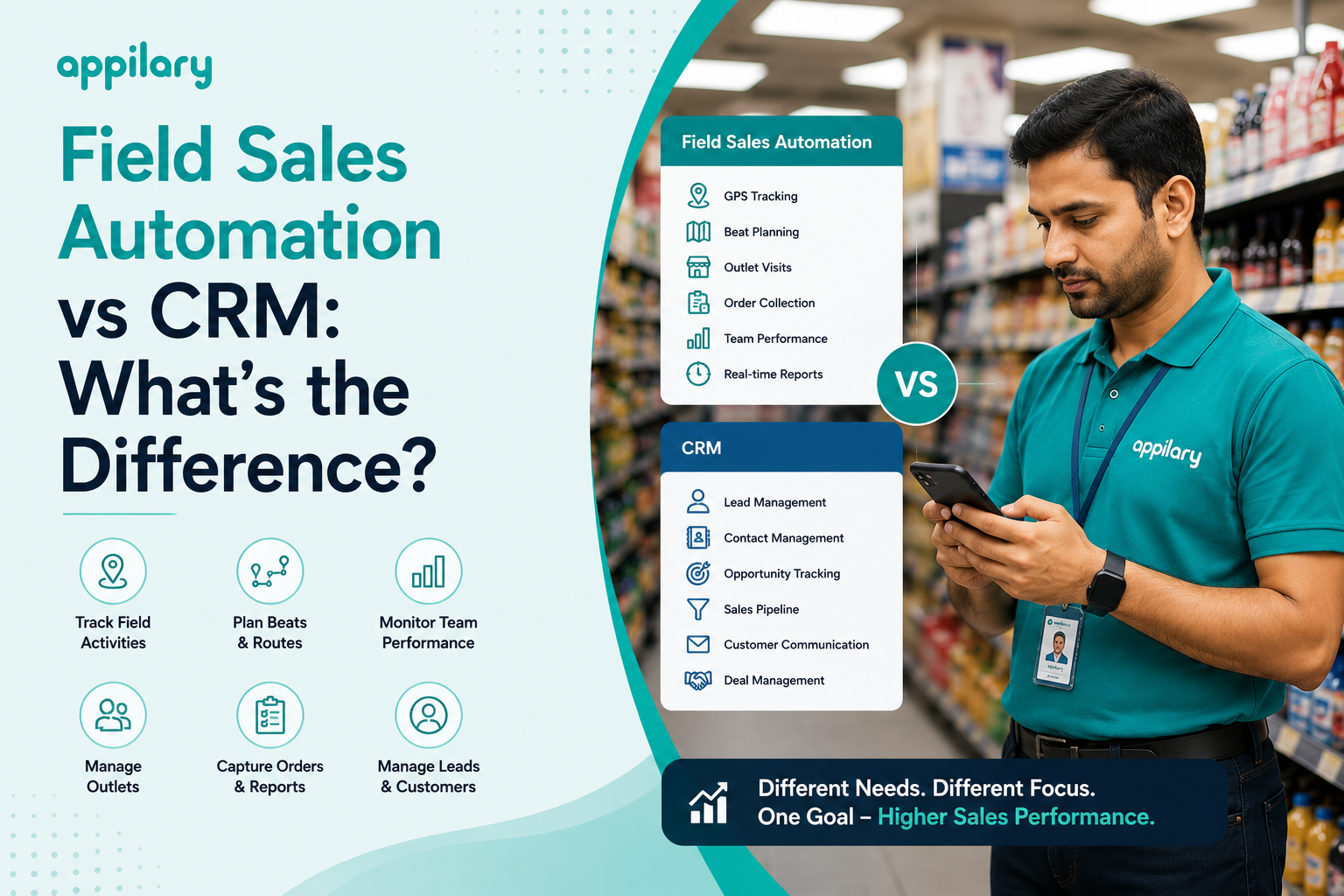
If your sales team spends most of its day meeting customers, visiting retailers, taking orders, following beat plans, and working in the field, you may have wondered whether you need a CRM or field sales automation software. At first glance, both tools can look similar. Both can help sales teams manage customers, record activities, monitor performance, and improve sales processes.
But there is an important difference. A CRM (Customer Relationship Management) system is primarily designed to manage customer relationships, leads, opportunities, sales pipelines, and customer information. Field sales automation software, on the other hand, is designed specifically to manage and automate the activities of salespeople who work outside the office.
This becomes especially important for industries such as FMCG, consumer goods, pharmaceuticals, distribution, retail, consumer durables, and other field-based businesses.
So, field sales automation vs CRM — which one should your business use?
What Is CRM Software?
CRM stands for Customer Relationship Management.
A CRM system helps businesses organize and manage their interactions with customers and prospects throughout the sales process.
A typical CRM can help sales teams manage:
- Leads
- Contacts
- Customer information
- Sales opportunities
- Follow-ups
- Sales pipelines
- Deals
- Emails and communication
- Customer history
- Sales reports
For example, imagine a B2B sales representative is trying to close a deal with a company.
The CRM can show:
Lead → Contact → Meeting → Proposal → Negotiation → Won/Lost
This makes a CRM particularly useful for inside sales, B2B sales, account management, and relationship-driven selling.
What Is Field Sales Automation Software?
Field sales automation software is built around the daily activities of sales representatives working in the field. Instead of focusing mainly on leads and sales pipelines, it helps businesses manage activities such as:
- Sales representative tracking
- GPS-based field tracking
- Outlet visits
- Beat planning
- PJP management
- Route planning
- Attendance
- Geo-verification
- Order collection
- Retailer management
- Target tracking
- Sales reporting
- Field activity monitoring
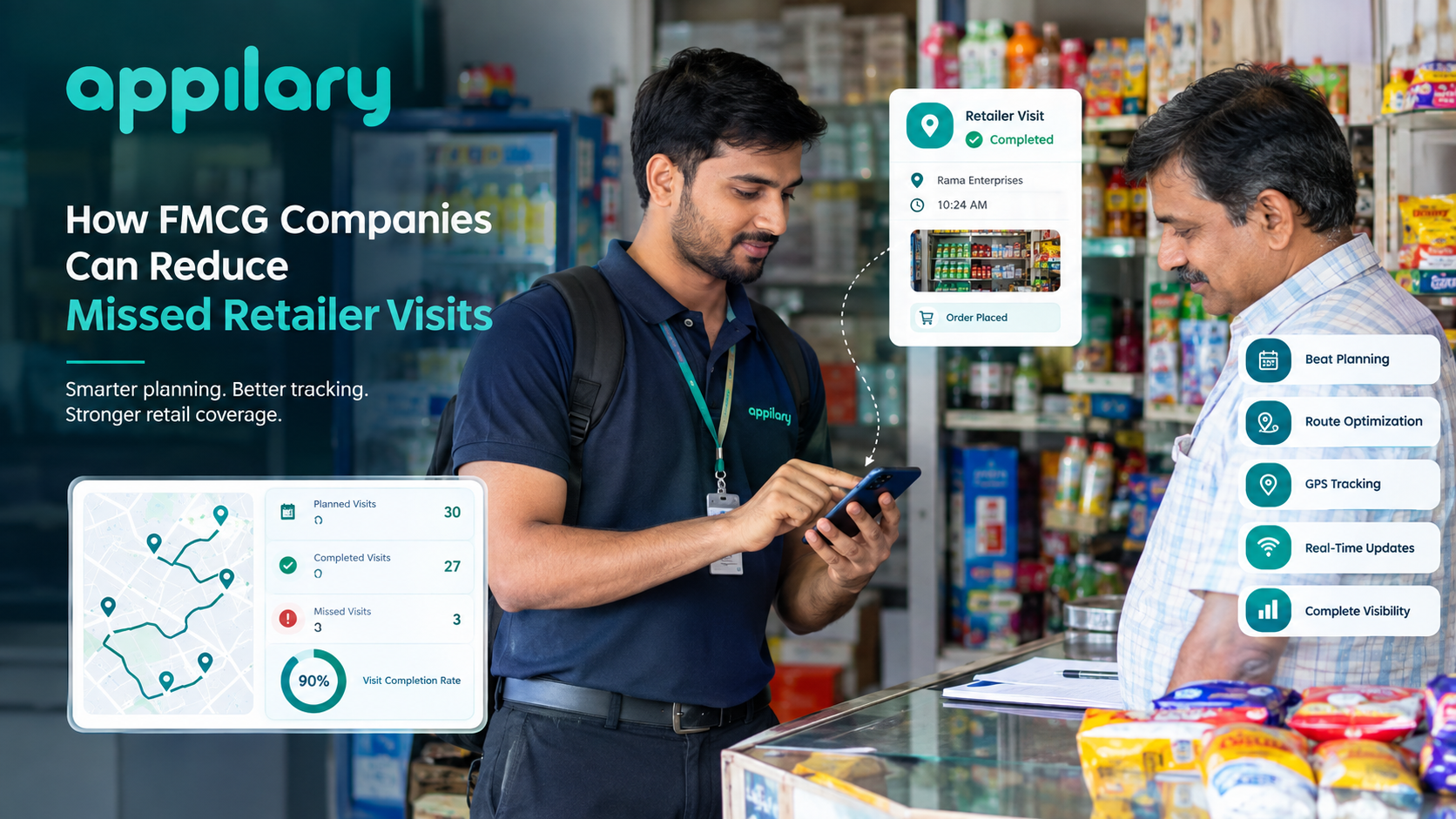
For example, an FMCG sales representative may have a daily plan to visit 30 retailers. A field sales automation system can help the manager see:
30 Planned Visits → 24 Completed → 4 Missed → 2 Additional Visits
The manager can also review sales, visit locations, productivity, and target achievement from a centralized dashboard.
Field Sales Automation vs CRM: The Key Difference
The easiest way to understand the difference is to look at what each solution is designed to manage. CRM software focuses mainly on customer relationships, leads, opportunities, and the sales pipeline. Field sales automation software focuses on the day-to-day activities of sales representatives working in the field.
For example, a CRM can help a manager understand which leads are active and which deals are likely to close, while field sales automation software can help the same manager understand which retailers were visited, which sales representatives completed their planned visits, whether the assigned beat was followed, and how the field team performed.
What Does CRM Software Manage?
A Customer Relationship Management (CRM) system helps businesses organize customer information and manage the sales process from lead generation to deal closure.
Common CRM capabilities include:
- Lead Management: Capture, organize, assign, and track potential customers.
- Customer Relationship Management: Maintain customer profiles, interactions, and communication history.
- Sales Pipeline Management: Track opportunities as they move through different stages of the sales process.
- Opportunity Management: Monitor potential deals, their value, status, and expected closure.
- Follow-Up Management: Schedule and manage follow-ups with leads and customers.
- Deal Management: Track negotiations, proposals, and completed or lost deals.
- Customer History: Maintain a centralized record of previous interactions and activities.
- Communication Tracking: Record relevant emails, calls, meetings, and other customer interactions.
- Account Management: Manage customer accounts and important account-level information.
- Sales Reporting: Generate reports related to leads, opportunities, conversions, deals, and pipeline performance.
What Does Field Sales Automation Software Manage?
Field sales automation software is designed for businesses where sales representatives spend a significant amount of time visiting retailers, distributors, dealers, customers, or other locations.
It helps managers plan field activities, monitor execution, and measure the performance of their sales teams.
Common capabilities include:
- Field Team Management: Manage sales representatives and their assigned territories, markets, and activities.
- Sales Representative Tracking: Monitor field activities and relevant location-based information of sales representatives.
- Beat Planning: Create and assign structured FMCG beat plans based on markets, territories, and outlets.
- Outlet Visit Management: Plan, record, and monitor visits to retailers, dealers, distributors, and other outlets.
- GPS-Based Tracking: Use GPS-enabled tracking to provide visibility into field movement and assigned activities.
- Route Monitoring: Monitor planned routes and compare field execution against assigned routes.
- PJP Management: Create and manage Permanent Journey Plans (PJP) for recurring sales visits.
- Attendance Tracking: Digitize field attendance and provide managers with better visibility into team availability.
- Geo-Verification: Verify whether a sales representative's activity or visit occurred at the assigned location.
- Field Sales Reporting: Capture sales activities, visits, orders, observations, and other field information digitally.
- Target Tracking: Monitor sales targets and compare actual performance against assigned goals.
- Outlet Coverage: Track planned versus completed outlet visits to identify coverage gaps.
- Real-Time Dashboards: Give sales managers a centralized view of field activities, sales performance, and team productivity.
Both systems can be valuable, but their primary purposes are different.
Where Does CRM Work Best?
CRM software is particularly useful when your sales process involves leads, prospects, opportunities, and long sales cycles.
For example:
B2B Sales
A salesperson may communicate with a prospect several times before closing a deal.
Enterprise Sales
Multiple decision-makers, proposals, negotiations, and follow-ups need to be managed.
Inside Sales
Sales representatives may spend most of their time communicating through phone calls, email, video meetings, and online channels.
Account Management
Companies need a centralized history of customer interactions and relationships.
In these situations, a CRM can provide valuable visibility into the sales pipeline.
Where Does Field Sales Automation Work Best?
Field sales automation becomes particularly useful when salespeople spend significant time outside the office.
Consider an FMCG company with 100 sales representatives.
Each representative may need to:
- Visit retailers
- Follow a daily beat
- Collect orders
- Check product availability
- Execute merchandising activities
- Meet distributors
- Achieve daily targets
- Submit visit reports
Trying to manage all of this through a traditional CRM or spreadsheets can become difficult.
A field force management software platform can provide tools specifically designed for these activities.
1. GPS Tracking
One of the biggest differences between traditional CRM systems and field sales tracking software is location-based field visibility. With GPS-enabled field sales software, managers can monitor relevant field activity through location data, subject to the organization's policies and applicable privacy requirements.
This can help answer questions such as:
- Where is the sales representative working?
- Which outlets were visited?
- Was the planned route followed?
- When did the visit happen?
- Which locations were covered?
This is particularly useful for geographically distributed FMCG sales teams and field sales forces.
2. Beat Planning
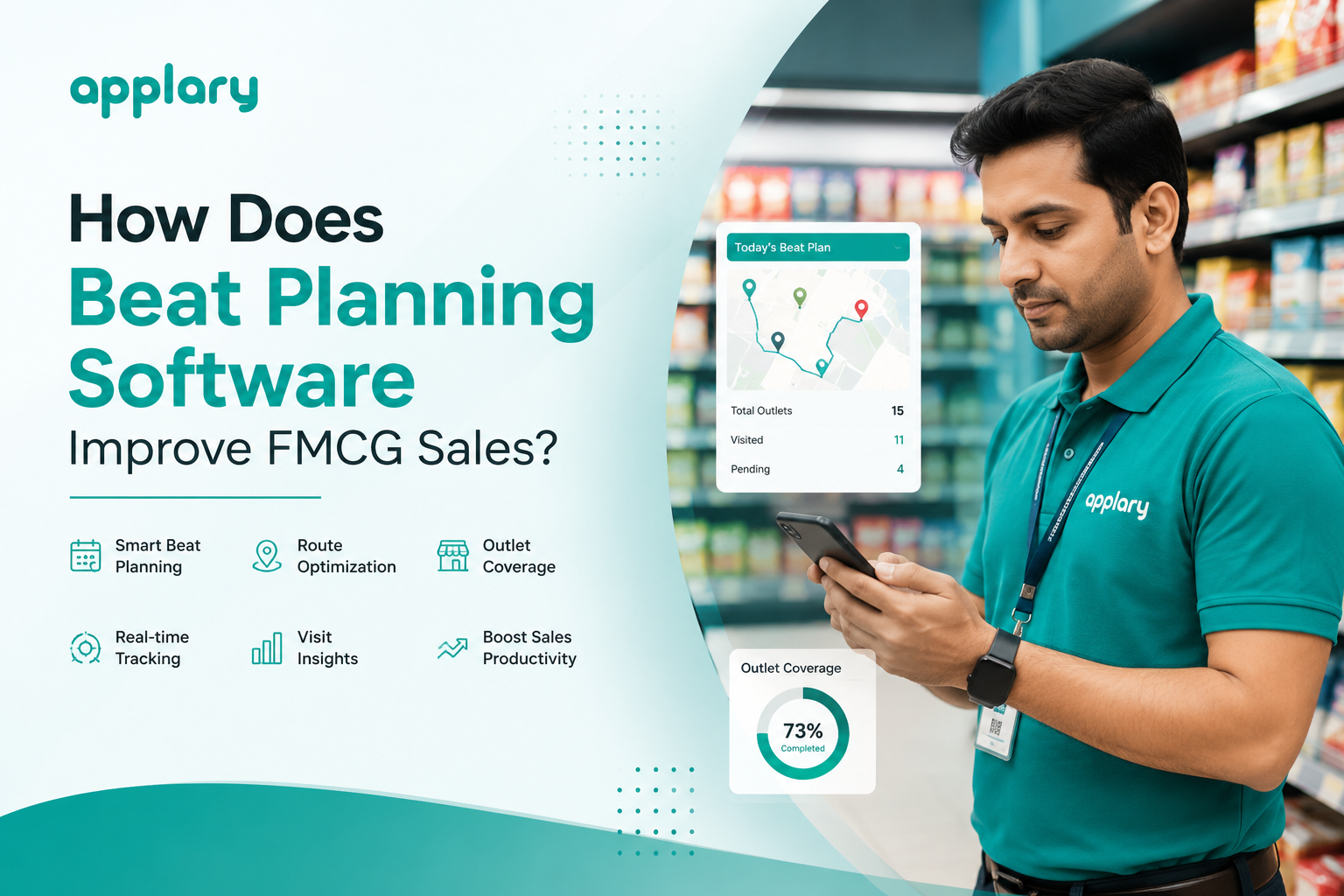
Beat planning is an important part of FMCG field sales management. A beat plan determines which outlets a salesperson should visit on a particular day or period.
For example:
Monday → Market A
Tuesday → Market B
Wednesday → Market C
Thursday → Market D
Friday → Market E
With beat planning software, managers can digitally assign and monitor these plans instead of depending on spreadsheets or manual instructions. A CRM generally isn't designed specifically around this type of outlet-based field execution.
3. PJP Management
PJP stands for Permanent Journey Plan. It helps sales managers organize recurring sales visits across territories and outlets. Field sales software can help managers create, assign, and monitor PJPs while comparing planned activities with actual field execution. This is particularly relevant to FMCG sales automation and field force management.
4. Outlet Visit Tracking
For FMCG and retail-focused businesses, the outlet is often more important than the traditional "lead."
A field sales application can capture information related to:
- Retailer visits
- Visit time
- Location
- Orders
- Product availability
- Merchandising
- Stock information
- Photos
- Visit remarks
This creates a digital record of field execution.
5. Sales Representative Performance
A CRM might show how many deals a salesperson has closed. But field sales automation can provide a broader view of field sales performance.
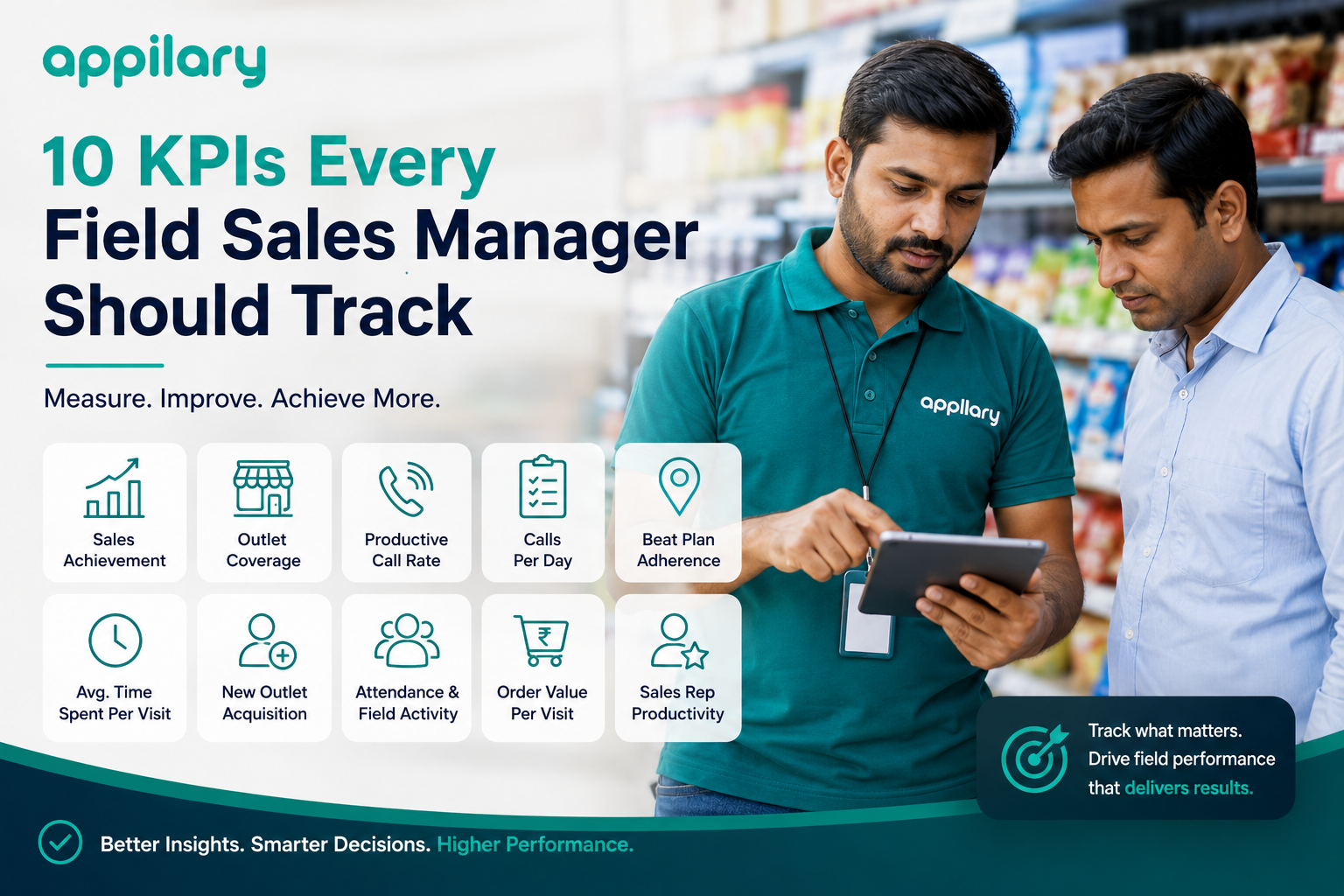
Managers can track metrics such as:
- Planned visits
- Actual visits
- Productive calls
- Missed visits
- Beat completion
- Outlet coverage
- Sales target
- Target achievement
- Orders
- Average order value
- Field activity
This helps managers understand not just what was sold, but also what happened in the field before the sale.
6. Real-Time Field Reporting
Traditional field reporting often looks like this: Salesperson visits outlets → writes information down → prepares report → submits report → manager reviews it
By the time the manager receives the report, the sales day may already be over. With field sales automation software, field activity can be captured digitally and made available through dashboards and reports, depending on the system's configuration and connectivity.
This can reduce manual reporting and improve visibility.
7. CRM vs Field Sales Automation for FMCG
This difference becomes even clearer in FMCG.
Imagine an FMCG company has:
500 Sales Representatives
20 Distributors
50,000 Retailers
Multiple States
The company needs to manage not only customers and sales opportunities but also thousands of daily field activities. The manager may need to know: Did the salesperson visit the assigned retailer? Was the beat completed? How many productive calls were made?
How much sales was generated?
Which outlets were missed?
Which territory is underperforming?
Are representatives following their planned routes?
These are primarily field execution questions.
This is where FMCG field sales software and field force management software can provide specialized capabilities.
Can a Business Use Both CRM and Field Sales Automation?
Yes. In fact, for some organizations, using both can create a stronger sales ecosystem.
For example:
CRM
Handles:
Leads → Opportunities → Customers → Deals → Relationships
while
Field Sales Automation
Handles:
Beat → Route → Outlet Visit → Order → Field Activity → Target → Performance
The two systems can complement each other when integrations are available.
When Should You Choose Field Sales Automation?
Consider field sales automation software if your business has:
- A large field sales team
- Sales representatives visiting retailers
- Distributor networks
- Thousands of outlets
- Daily or weekly beat plans
- Territory-based sales operations
- GPS tracking requirements
- Field attendance requirements
- Frequent outlet visits
- Manual sales reporting
- Difficulty monitoring field employees
- Problems with outlet coverage
Industries that may benefit include:
FMCG | Consumer Goods | Pharmaceuticals | Consumer Durables | Retail | Distribution | Building Materials | Food & Beverage
When Should You Choose CRM?
A CRM may be the better starting point if your business primarily needs:
- Lead management
- Customer relationship management
- Sales pipeline management
- Opportunity tracking
- Follow-up management
- Deal management
- Account management
- Customer communication history
- Sales forecasting
For a company whose sales process revolves around leads and opportunities rather than physical outlet visits, CRM may be more important.
How Field Sales Automation and CRM Can Work Together
The two systems don't necessarily have to compete.
A business can use CRM for the customer and sales relationship layer and field sales automation for the field execution layer.
For example:
Step 1 — CRM
A new customer or opportunity is created.
Step 2 — Field Assignment
The customer or outlet is assigned to a field representative.
Step 3 — Beat Planning
The representative receives the appropriate route or visit plan.
Step 4 — Field Visit
The salesperson visits the location and records the activity.
Step 5 — Order
The representative captures the order.
Step 6 — Reporting
The manager sees the field activity and sales performance.
Step 7 — CRM Update
Relevant customer or opportunity information can be synchronized back to the CRM when an integration is available.
This creates a connected sales process.
Why Field Sales Automation Is Important for FMCG Companies
FMCG sales are highly dependent on distribution, retailer coverage, sales representative productivity, availability, visibility, and execution.
A salesperson can have excellent sales skills, but if the right outlets are not visited consistently, opportunities can still be missed.
That's why FMCG companies need to monitor more than revenue.
They need visibility into the entire field journey:
Salesperson → Route → Beat → Outlet → Visit → Order → Sales → Performance
Field sales automation connects these activities into one digital workflow.
Benefits of Field Sales Automation
Better Field Visibility
Managers get greater visibility into field activities and sales execution.
Improved Outlet Coverage
Digital beat plans and visit tracking can help reduce missed retailer visits.
Better Sales Productivity
Managers can identify how effectively representatives are using their working time.
Less Manual Reporting
Digital field reports reduce dependence on spreadsheets and manual updates.
Faster Decision-Making
Managers can use current field information to identify gaps and take action.
Better Accountability
Planned activities can be compared with actual execution.
Data-Driven Management
Sales managers can use field data rather than relying entirely on assumptions or manual reports.
Field Sales Automation vs CRM: Which One Is Better?
There isn't one universal winner.
It depends on what your sales team actually does.
If your primary challenge is:
"How do we manage leads, customers, opportunities and deals?"
→ CRM is likely the better fit.
If your primary challenge is:
"How do we manage salespeople, outlets, routes, visits, beats and field performance?"
→ Field Sales Automation is likely the better fit.
If you have both requirements, consider a connected approach using CRM + field sales automation.
The Future of Field Sales Management
Sales teams are moving away from disconnected spreadsheets, manual reports, and phone-based monitoring toward more connected digital workflows. Modern field sales management software can bring together: GPS Tracking + Beat Planning + PJP + Attendance + Outlet Visits + Order Capture + Target Tracking + Sales Reports + Analytics
This gives sales managers a much clearer view of what's happening across the field. The goal isn't simply to track employees.
The goal is to help sales teams work smarter, cover more outlets, reduce operational inefficiencies, and improve sales execution.
Conclusion
Field Sales Automation and CRM are not the same thing.
A CRM primarily focuses on customers, leads, opportunities, relationships, and sales pipelines, while field sales automation focuses on sales representatives, field activities, outlets, beats, routes, visits, GPS tracking, orders, and field performance.
For businesses with large field teams—especially FMCG and distribution companies—field sales automation can solve operational challenges that a traditional CRM may not be designed to handle.
The right choice ultimately depends on your sales model.
If your team spends most of its time inside the office managing leads and deals, a CRM may be the priority.
If your team spends most of its time outside the office visiting retailers, distributors, dealers, or customers, a field sales automation platform can provide the specialized tools needed to manage that operation effectively. And when both customer relationship management and field execution matter, integrating the two can create a more complete sales ecosystem.