Introduction
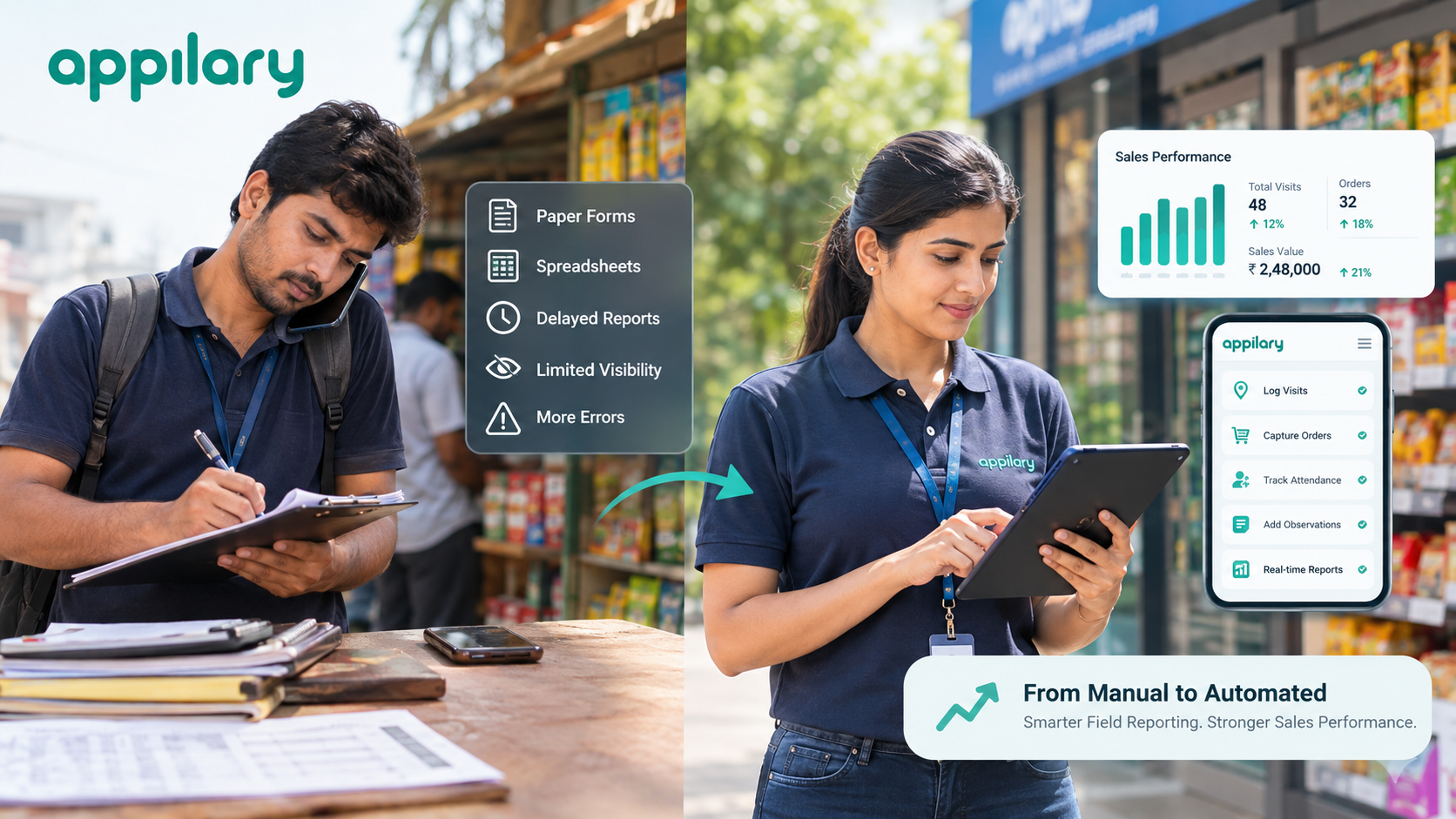
For many businesses, field sales reporting is still a time-consuming process. Sales representatives visit retailers, collect information, record orders, take photographs, and submit daily reports through spreadsheets, paper forms, phone calls, or messaging applications. Although these methods may work for small teams, they become increasingly difficult to manage as businesses expand their field sales operations.
Delayed reports, inaccurate data, limited field visibility, and time-consuming administrative work can prevent sales managers from making informed decisions. These challenges are encouraging businesses to move from manual field reporting to sales force automation software that streamlines field activities and provides real-time access to sales performance data.
From FMCG distribution and retail execution to territory management and sales performance monitoring, field sales automation is helping businesses improve operational efficiency, strengthen accountability, and make data-driven decisions.
But what makes sales automation a better alternative to traditional reporting? Let's explore.
What Is Manual Field Sales Reporting?
Manual field sales reporting is the process of collecting, recording, and sharing sales-related information without an integrated automation system.
Sales representatives typically record retailer visits, orders, product availability, merchandising activities, and market observations using spreadsheets, paper-based forms, or messaging applications. Sales managers then consolidate this information to prepare reports and evaluate team performance.
While manual reporting may appear straightforward, it often creates operational challenges when multiple representatives, distributors, territories, and retail outlets are involved.
Common challenges include:
- Delayed submission of daily sales reports.
- Errors caused by manual data entry.
- Limited visibility into field sales activities.
- Difficulty tracking retailer visits and sales orders.
- Time-consuming report preparation and data consolidation.
- Lack of reliable, real-time sales performance insights.
- Difficulty identifying missed visits and execution gaps.
As businesses grow, these limitations can affect sales productivity, reporting accuracy, and overall field force management.
Why Are Businesses Moving to Sales Automation?
Sales automation replaces repetitive manual processes with digital workflows that help sales teams capture, manage, and analyse information more efficiently.
Here are the key reasons businesses are adopting field sales automation software.
1. Real-Time Sales Reporting Instead of Delayed Updates
One of the biggest limitations of manual reporting is the delay between field activity and management visibility. Sales representatives may submit reports at the end of the day, while managers may need additional time to consolidate data from multiple sources.
With real-time sales reporting software, field teams can record retailer visits, order details, stock availability, and market observations directly through a mobile application.
Sales managers can access updated information through centralised dashboards and reports, helping them monitor daily performance and respond to operational issues more quickly.
Business benefit: Faster reporting, improved visibility, and more timely decision-making.
2. Improved Field Team Tracking and Accountability
Managing a distributed sales team requires visibility into where representatives are working, which outlets they have visited, and whether planned activities have been completed.
Manual reporting makes it difficult to verify field activities consistently. Sales force automation software can support GPS-enabled attendance, location-based visit verification, route tracking, and beat plan monitoring, subject to the organisation's configuration and permissions.
These capabilities help sales managers compare planned visits with actual execution and identify missed retailer visits or deviations from assigned routes.
Business benefit: Better field force management, improved accountability, and more effective territory coverage.
3. Reduced Manual Errors and Better Data Accuracy
Spreadsheets and paper-based forms often require sales representatives to enter the same information multiple times. This increases the possibility of duplicate records, missing fields, inconsistent product names, and incorrect sales figures.
Sales reporting automation standardises data collection through structured forms, predefined fields, validation rules, and automated calculations.
For example, a field sales application can capture retailer details, sales orders, product availability, and visit outcomes in a consistent format. Managers can then analyse standardised information instead of correcting multiple versions of manually prepared reports.
Business benefit: More reliable sales data and less time spent correcting reporting errors.
4. Increased Sales Representative Productivity
Sales representatives need to spend their time selling, developing retailer relationships, collecting orders, and improving market coverage—not preparing lengthy reports after every visit.
Manual reporting creates administrative work that can reduce the time available for customer interactions.
Field sales automation streamlines routine tasks such as visit logging, order capture, attendance marking, and daily reporting. Mobile-based workflows also allow representatives to record information closer to the point of activity.
This makes sales productivity improvement an important reason for businesses to automate field operations.
Business benefit: Less administrative work and more time for revenue-generating activities.
5. Better Sales Performance Monitoring Through Dashboards
Manual reports often provide historical information without making performance gaps easy to identify. Sales managers may need to combine several spreadsheets before they can understand territory performance, representative productivity, or outlet coverage.
Sales force management software brings key performance indicators into centralised dashboards.
Depending on the platform, these dashboards may help monitor:
- Daily sales and order performance.
- Retailer visit completion rates.
- Beat plan and territory coverage.
- Product availability and stock observations.
- Sales representative productivity.
- Merchandising and promotional execution.
- Outlet-level and territory-level performance.
With consolidated sales analytics, managers can identify underperforming areas, compare results, and prioritise corrective action.
Business benefit: Greater operational visibility and more informed sales performance management.
6. Stronger Retail Execution and FMCG Distribution Management
For FMCG businesses, sales success depends on more than achieving sales targets. It also involves maintaining product availability, ensuring effective merchandising, monitoring promotional activities, and improving retailer coverage.
Manual reporting can make these activities difficult to monitor consistently across large retail networks.
FMCG sales automation software helps businesses digitise retailer visits, capture outlet-level information, monitor product availability, and record merchandising execution. Depending on the solution, image-based checks can also help assess product placement and point-of-sale material compliance.
When field data is available in a structured format, businesses can identify execution gaps and take action to improve retail visibility and distribution effectiveness.
Business benefit: Better retail execution, improved market visibility, and more consistent field operations.
7. Faster Decision-Making With Data-Driven Insights
Business decisions are only as effective as the information supporting them. When sales data arrives late or contains inconsistencies, managers may struggle to identify emerging problems and respond quickly.
Sales automation helps create a centralised source of field information that can be used to analyse trends, compare territories, and monitor progress against business objectives.
For example, if a territory shows declining retailer coverage or repeated product availability issues, managers can investigate the underlying causes and adjust their sales strategy.
Advanced platforms may also offer predictive analytics, automated alerts, and AI-powered retail intelligence to support more proactive decision-making.
Business benefit: Better-informed decisions based on timely, actionable field data.
8. Scalable Sales Operations Without Increasing Administrative Work
As a business expands into new territories, adds distributors, or increases its field sales workforce, manual reporting becomes harder to maintain.
More representatives generate more reports, spreadsheets, and data that need to be checked and consolidated.
Sales automation creates standardised workflows that can be extended across teams and locations. Managers can apply consistent reporting processes, define role-based access, and monitor performance through a common system.
This makes field sales management software particularly valuable for growing FMCG companies, consumer goods brands, and businesses operating across multiple markets.
Business benefit: More consistent processes and better control as field operations grow.
Manual Field Reporting vs Sales Automation: What's the Difference?
The fundamental difference is how sales information is captured, processed, and used.
- Data collection: Manual entry through spreadsheets or paper forms versus structured digital data capture.
- Reporting speed: Periodic report submission versus near-real-time updates, depending on connectivity and system configuration.
- Field visibility: Limited visibility between reporting cycles versus centralised monitoring of field activities.
- Data accuracy: Greater exposure to manual entry errors versus validation rules and standardised workflows.
- Performance analysis: Manual consolidation versus dashboards and automated reports.
- Team productivity: More time spent on administration versus streamlined reporting processes.
- Scalability: Increasing reporting complexity as teams grow versus repeatable digital workflows.
Sales automation does not eliminate every operational challenge, but it gives businesses better tools to manage field activities, improve data quality, and reduce repetitive administrative work.
How to Choose the Right Field Sales Automation Software
Choosing the right platform requires more than comparing features. Businesses should evaluate how effectively a solution supports their actual sales processes.
Consider the following factors before investing in field sales management software.
1. Mobile-based reporting: Ensure representatives can record visits, orders, and outlet information easily from their mobile devices.
2. Real-time dashboards: Look for reporting capabilities that provide timely visibility into sales performance, field activities, and territory coverage.
3. GPS and attendance tracking: Evaluate location-enabled features that support transparent field activity monitoring and appropriate privacy controls.
4. Beat and route management: Choose a system that supports planned retailer visits, territory allocation, and visit completion monitoring.
5. Retail execution capabilities: For FMCG businesses, consider product availability tracking, merchandising checks, promotional compliance, and outlet-level reporting.
6. Integration and scalability: Check whether the platform can integrate with existing business systems and support your future operational requirements.
7. Offline functionality: If representatives work in areas with unreliable internet connectivity, evaluate whether the application can capture data offline and synchronise it later.
The right solution should simplify everyday field operations while giving management reliable information to improve execution and performance.
The Future of Field Sales Management
Field sales management is evolving from periodic reporting towards connected, data-driven operations. Mobile applications, cloud-based dashboards, automated workflows, and AI-powered retail analytics are making it possible to understand field performance with greater speed and consistency.
Businesses are increasingly looking for systems that combine sales force automation with retail execution, distributor visibility, and actionable market intelligence.
Rather than simply recording what happened in the field, modern sales automation platforms can help managers identify where execution is falling short and determine what needs attention next.
For organisations operating across large retail networks, this shift can support stronger coordination between field representatives, sales managers, distributors, and business leadership.
How Appilary Helps Businesses Modernise Field Sales Reporting
Appilary helps businesses streamline field sales operations through digital field force management and sales automation capabilities.
By moving away from disconnected reporting processes, organisations can build more structured workflows for monitoring field activities, improving retail visibility, and analysing sales execution.
Depending on the selected platform capabilities, businesses can use features such as:
- Field force management: Organise and monitor field sales activities.
- Beat and route management: Improve planned retailer coverage and visit execution.
- GPS-enabled attendance and tracking: Support field activity visibility.
- Digital reporting and dashboards: Consolidate field information for easier performance monitoring.
- Retail execution monitoring: Capture outlet-level observations and merchandising activities.
- Retail intelligence: Use available analytics and image-based insights to identify execution gaps.
For FMCG brands and businesses with distributed field teams, the objective is straightforward: reduce reporting effort, improve operational visibility, and give sales managers more actionable information.
Explore Appilary's field sales automation solutions to understand how digital workflows can support more efficient field operations.
Conclusion
The move from manual field reporting to sales automation reflects a broader change in how businesses manage their sales operations. Paper forms, spreadsheets, and delayed updates can make it difficult to maintain accurate information, monitor field teams, and respond to market challenges.
With sales force automation software, businesses can streamline reporting, improve field visibility, monitor retail execution, and make better use of sales data.
For organisations aiming to improve sales productivity and scale their field operations, adopting field sales automation is a practical step towards more efficient, measurable, and data-driven sales management.
The key is to choose a solution that aligns with your business processes and helps your field teams spend less time reporting and more time executing.